What is the role of a Baffle fitting?
Four-way risers in plumbing or drainage systems often have baffle fittings to control flow, prevent cross-contamination, and improve system function. Here’s why they’re used:
1. Directing Flow Properly
- A four-way riser can connect multiple drains or vents. Without a baffle, water or waste could flow the wrong way, especially if multiple lines discharge at once.
- Baffles guide flow from each inlet downward into the main riser, helping prevent backflow or turbulent mixing.
2. Preventing Cross-Flow
- In sanitary systems, it’s important that waste from one branch doesn’t enter another. Baffles act as flow separators, ensuring that what enters one side doesn’t shoot across to another side and cause blockages or contamination.
3. Improving Ventilation
- Good venting prevents vacuum conditions and keeps traps sealed. Baffles help channel air correctly through the venting side of the riser without being blocked or overwhelmed by liquid flow.
4. Minimizing Turbulence and Splashback
- When water enters a riser, especially from multiple directions, it can create turbulence. Baffles help smooth out flow and reduce splashing or hammering in the pipework.
5. Meeting Code Requirements
- Many plumbing codes require fittings that minimize the risk of cross-connection or hydraulic interference. Baffle fittings are often a compliance measure.
4 Way Riser and Baffle details
Here is the 4 Way Riser and baffle image with product details extracted from the Raupiano Plus Plumbing system catalogue.

Baffles in 4-way risers can be notoriously difficult to fit for a few key reasons, especially on-site. Here’s why they tend to be tricky:
1. Tight Internal Space
You’re working inside a pipe, often from above, and there’s limited room to maneuver tools, hands, or the fitting itself.
Aligning the baffle at the correct angle inside a confined vertical space is awkward and requires precision.
2. Orientation Matters
Baffles must be installed at specific angles to direct flow correctly and prevent crossflow.
If the baffle is even slightly misaligned, it can cause problems with drainage or backflow, so there’s little room for error.
3. Interference with Other Connections
In a 4-way riser, you’ve got inlets/outlets on multiple sides—the baffle must fit between these without blocking any of them.
If pipework is already installed, retrofitting a baffle is especially tough, since you’re navigating around other fittings or stubs.
4. Friction and Fit
Baffle fittings are often tight press-fits or need to be glued in place, which can require a lot of force in an awkward spot.
Any rough edges, dirt, or deformation inside the riser can make it hard to seat the baffle properly.
5. Special Tools or Techniques Required
Some baffles require jigs or custom install tools that aren’t always available on-site.
Others might be heat-welded or solvent-welded in place, which needs precision and patience—hard to manage inside a deep riser.
Baffle Fitting Tool
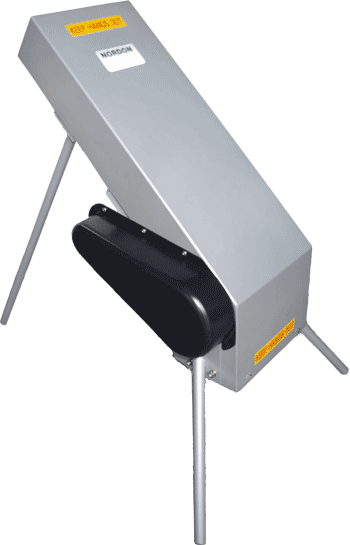
Designed and manufactured by Nordon, this purpose-built tool allows plumbers to quickly, accurately, and reliably install baffles into 4-way risers.
Onsite Efficency
Engineered for efficiency on-site, the Nordon Baffle Fitting Tool takes the hassle out of baffle installation by ensuring correct alignment and secure fit every time.
Durable & Ergonomic Design
With its durable construction and ergonomic design, this tool helps reduce installation time, minimise errors, and eliminate the frustration of working in tight spaces.
Whether you’re on a new build or retrofitting, it’s the go-to solution for a clean, consistent result.
Key Features:
Precision-fit alignment for fast and accurate installs
Built for tight access and confined riser spaces
Heavy-duty, trade-quality construction
Designed by plumbers, for plumbers
Make baffle fitting a one-person job—with the Nordon Baffle Fitting Tool.


Where to get Rehau Baffle Removal Pliers
Nordon Baffle Baffle Removal Pliers are available from Reece Plumbing
Refer: Reece Product Code – 31681


0 Comments